 |
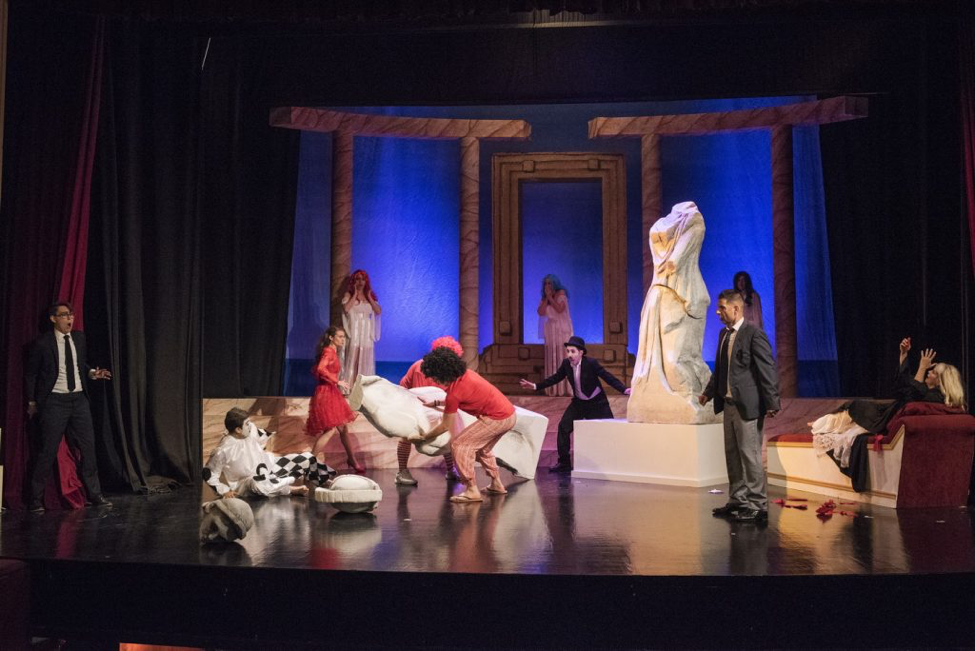
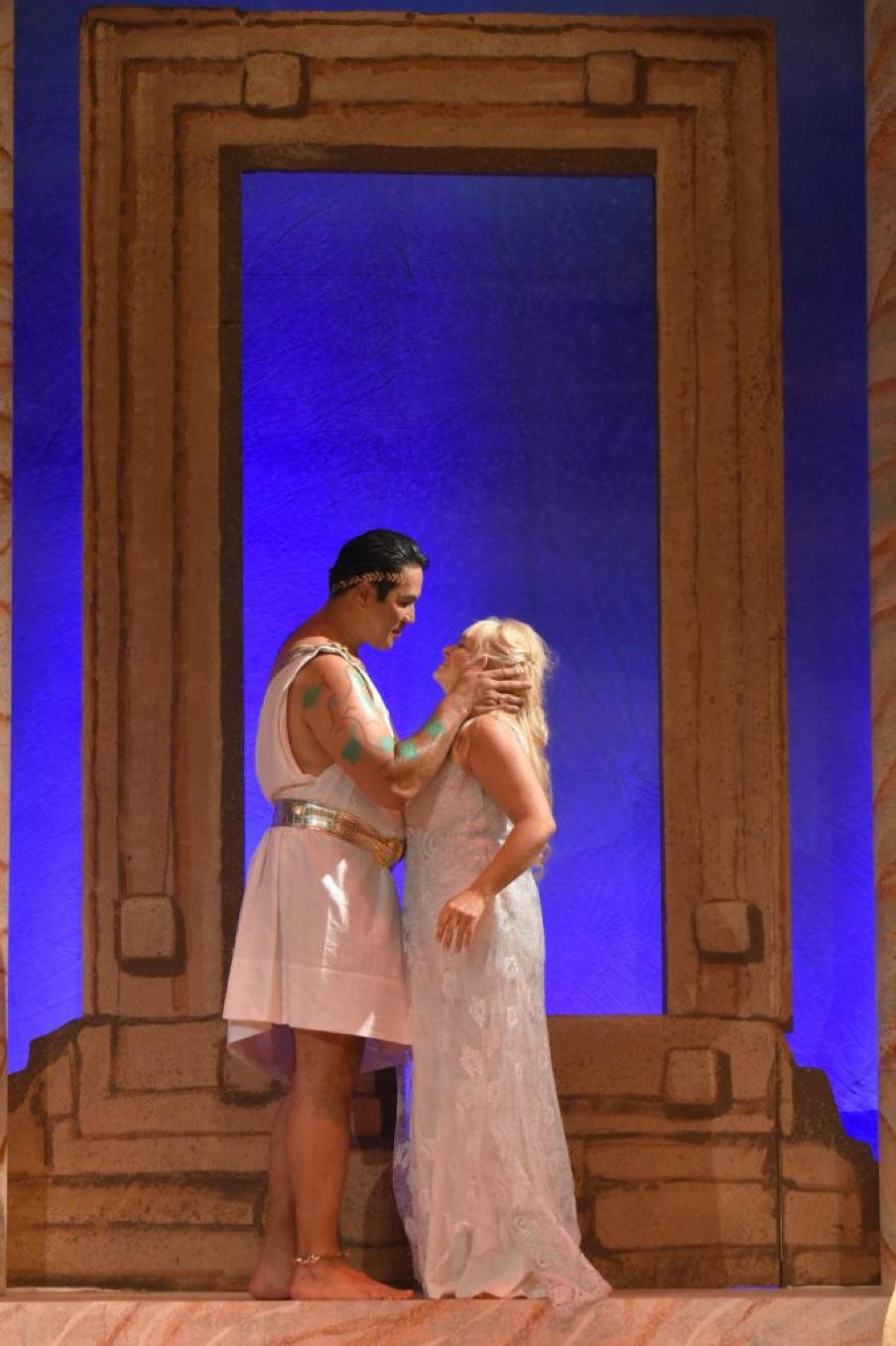
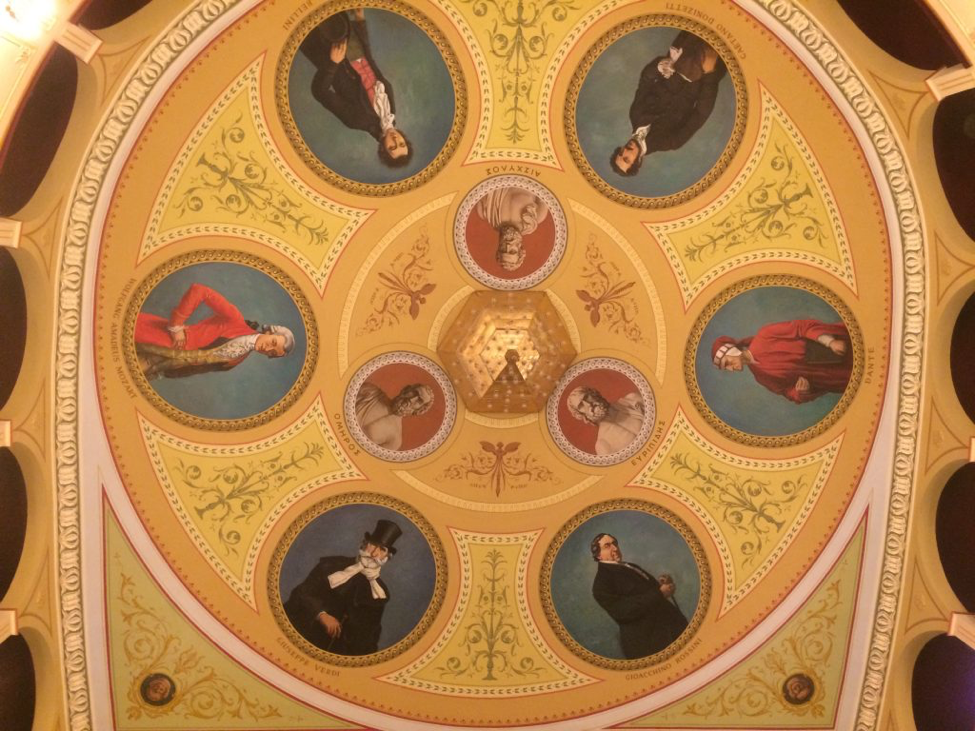
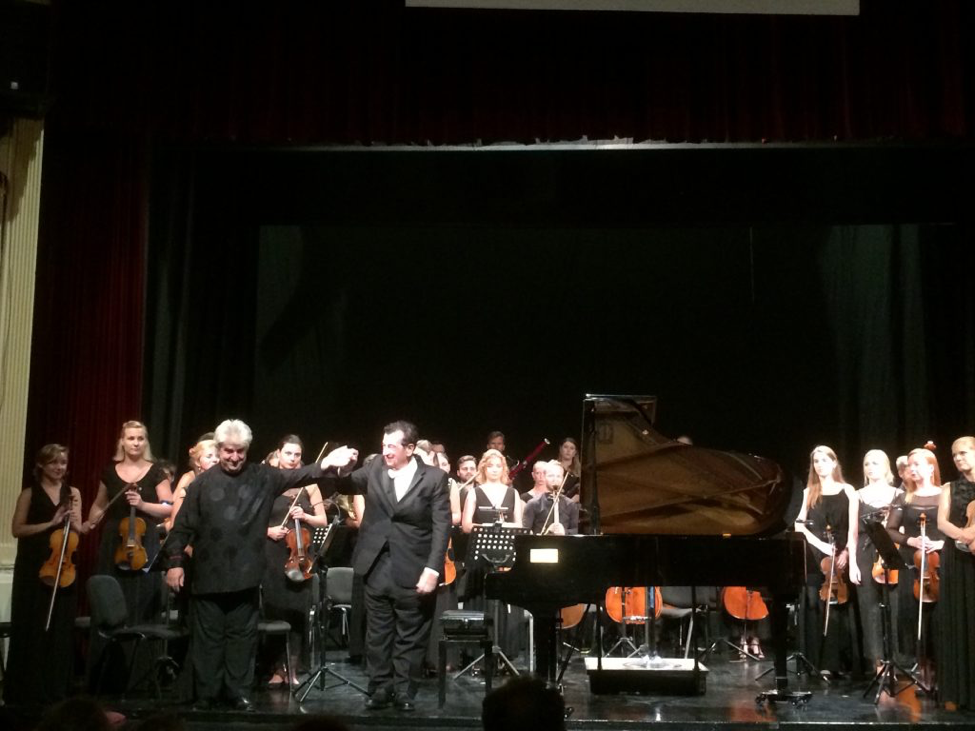
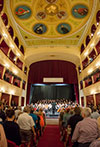
The island of Syros is a very important destination for music lovers. The center for many performances is the “Apollo” Theater in Hermoupolis. It opened in 1864 and it is a small exotic treasure in the world of opera, as is the “Angela Peralta” Theater in Mazatlan, Mexico or the Manoel Theater in Malta. Since 2005, it has been the home of the Festival of the Aegean, which is organized by the Greek-American conductor Peter Tiboris with his wife, soprano Eilana Lappalainen, and is focused on opera. The auditorium, of approximately 350 seats, has beautiful acoustics and, of course, does not need very big voices. This year’s big production of the Festival was Medea by Cherubini, but we managed to be there for the second week’s performances only.
On Tuesday, July 21, the evening started with a recital of German Song given by the young artists of the Greek Opera Studio, the educational part of the Festival. Thirteen young singers interpreted 14 songs by Schubert, Schumann and Mahler, while on the piano, the lecturer of the Vienna Hochschule, Pantelis Polychronidis, coached and accompanied them. His role was obvious in the stylistic unity and correctness of the interpretations, while on the piano, he accompanied very carefully and with great sensitivity. The small size of the theater allowed for all the voices to sound clean, clear and beautifully articulated.
On the second half, we watched “Mediterra” a performance of music from the Mediterranean by the ZZ Trio: Soprano Myrsini Margariti, flutist Natalia Gerakis, and pianist Zoe Zeniodi, three really exceptional musicians. We heard some famous songs, but also others that deserve to be heard more, such as “Corsica” by the contemporary songwriter Petru Guelfucci, or the traditional Turkish a cappella song “Yagmur yagar tas üstüne,” freely interpreted as a song of a girl who sings about love while watching the rain. From the pieces for flute and piano, we should single out “Memories” and “Hard Day” by Abdalla El-Masri (b. 1962), inspired by the civil war in Lebanon.
We also heard a two-part program on Wednesday, 22 July 2015. During the first half, soprano Lydia Zervanos interpreted songs by Manolis Kalomiris, Theodoros Spathis, Georgios Labelet, and Theofrastos Sakellaridis. Watching Lydia, we were reminded of her mother and teacher, Martha Arapi, who had sung in the Olympia Theater. The similarities include the vocal technique and control, the complete expression and stage presence, and the light conservatory-type interpretation, that totally fit songs like “Lagiarni” (c.1925) by Spathis, a short scene inspired by the pastoral life. The singer interpreted the very demanding and complex vocal writing with a phenomenal technique and grand rhetoric–the total opposite of the very beautiful approach by Myrsini Margariti, who, during the previous evening, had sung the lullaby from Smyrna by Kalomiris, with a simplicity of a folk-like inspiration. The soprano Marilena Striftobola interpreted two songs by Spyros Samaras, “Spring” and “I love you,” and one by Sakellaridis, with a wonderful diction, drawing kudos from the audience. Pantelis Polychronidis was on the piano.
During the second half, the artists of the Greek Opera Studio, took part in the semi-staged one-act opera “Suor Angelica” (New York, 1918), by Giacomo Puccini, a unique drama that takes place in a convent. The artistic direction was by Eilana Lappalainen, the music direction was by Zoe Zeniodi, and the pianist was Graham Cox. Kathryn Wieckhorst as Suor Angelica and Fotini Athanasaki as a princess gave a great dramatic intensity to the conflict between the two women. The most important advantage though was the presence of so many and so perfectly tuned and balanced voices, so that the hearing result was honestly angelic.
On Thursday, July 23, Christos Papageorgiou on the piano, on stage, and Theodoros Kerkezos on the saxophone, backstage, greeted us with Ave Maria by Gounod, and then continued with works by: Errikos Vaios, Astor Piazzolla, Gershwin, Manos Hadjidakis, and Christos Papageorgiou: Tango, and three of the “Stylistic Variations on a song by Mikis Theodorakis” for solo piano. The playing by the pianist highlighted the Iberian roots of the impressionistic “Piece en forma de Habanera” by Ravel, while the perfect technique of both was fully shown in “Scaramouche” by Darius Milhaud and in “Czardas” by the Spanish Pedro Iturralde.
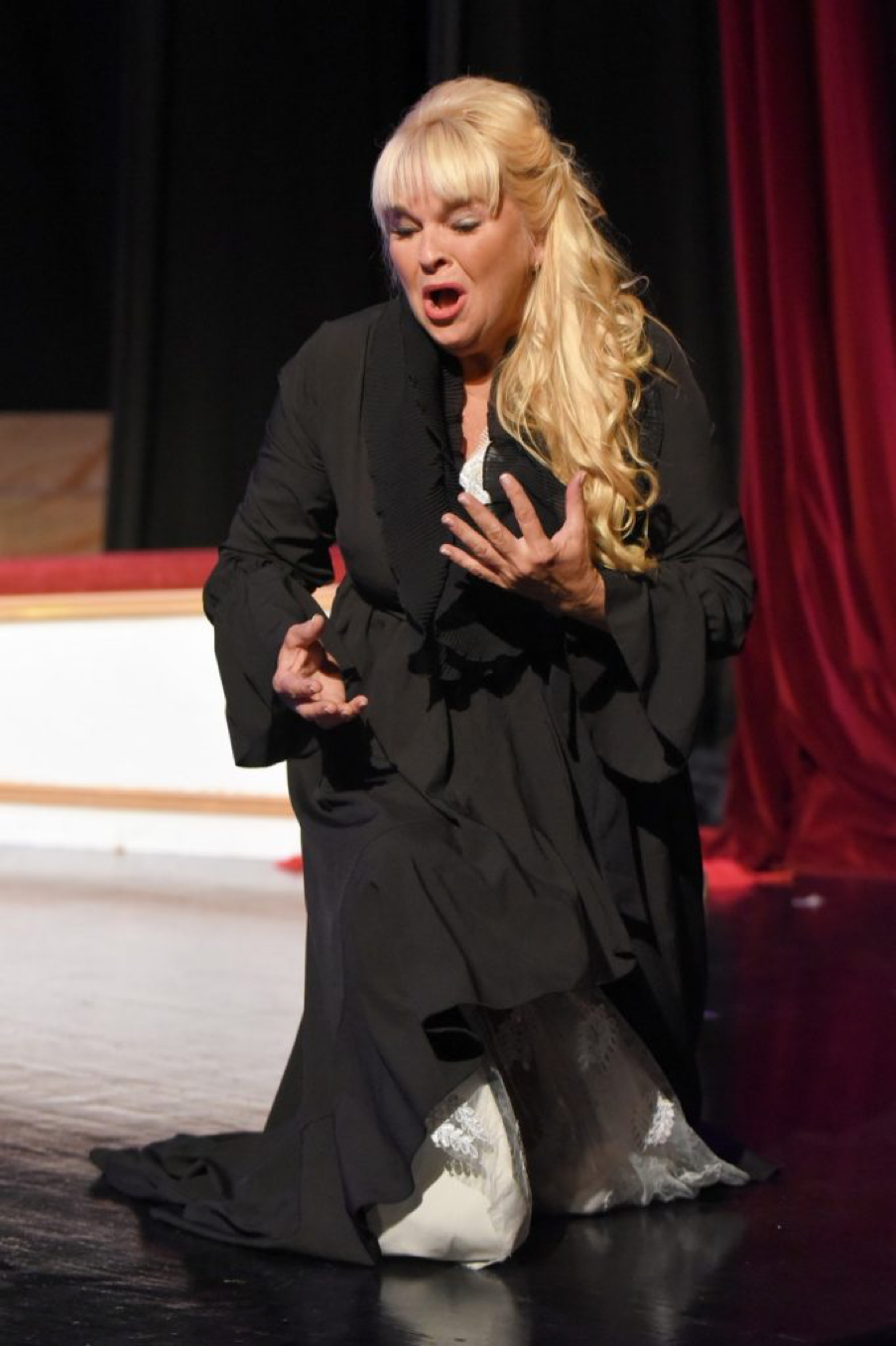
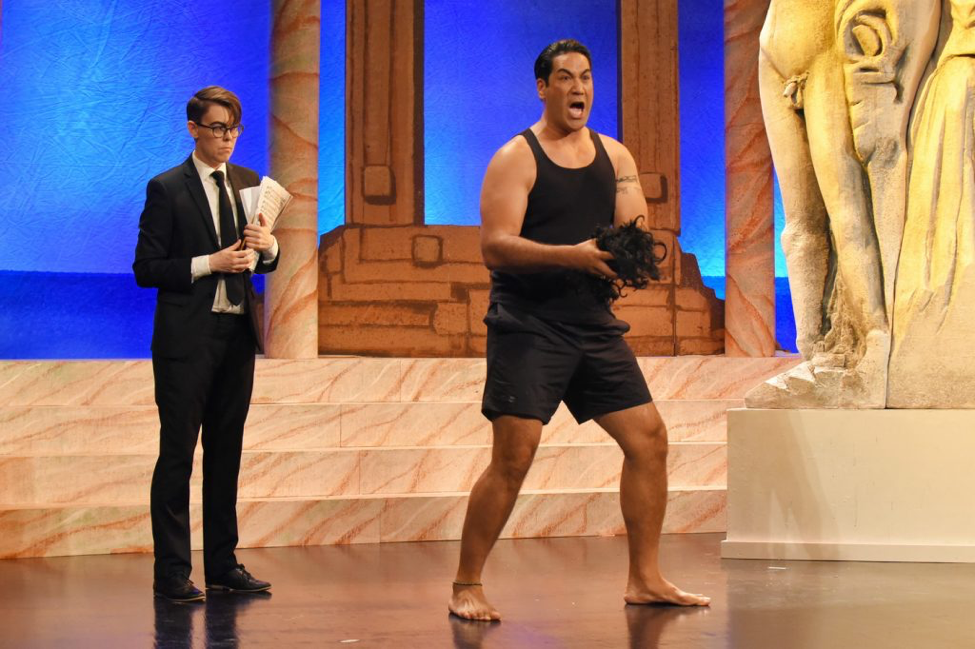
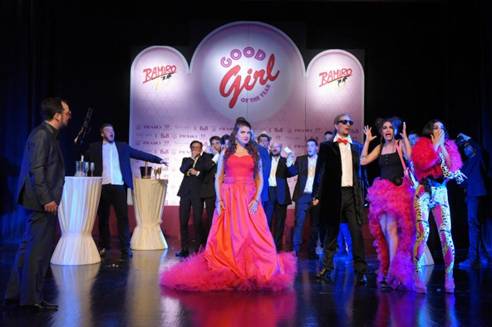
The Festival though remains focused on opera and on Friday, July 24, it closed with the Gala by the Greek Opera Studio. The Gala included a semi-staged performance with arias and scenes from famous operas by Mozart, Offenbach and others, but also rarer pieces such as Hindemith’s “Hin und Zurück” (Baden Baden, 1927). The pacing of the performance was good and the interpretations of a generally good level. In the interest of saving time here, let us mention the “Mad Scene” from Lucia di Lammermoor which was well interpreted and well-paced by the Australian soprano Jessica Boyd, the beautiful Mozartean song sung by the Belgian Lisa Meyvis, the easy and comfortable voice of the German baritone Andreas Post, and the boyish Cherubino by the extremely young Christina Tsourounaki.
Until we return to the Festival of the Aegean in 2016, summer in Syros continues with classical music, “eikastika” art, and other events. |
Press Release: Leadership 100,
February 25, 2015
LEADERSHIP 100 ANNUAL CONFERENCE PRESENTS
AWARDS FOR EXCELLENCE, APPROVES NEW GRANTS |
|
 |
George S. Tsandikos, Leadership 100 Chairman, addresses General Assembly. |
The 24th Annual Leadership 100 Conference, which took place February 12-15, 2015, at The Ritz-Carlton Orlando, Grande Lakes in Orlando, Florida, featured the presentation of the Archbishop lakovos Leadership 100 Award for Excellence to the renowned Greek academician, artist and designer, Ilias I. Lalaounis, who passed away in December of 2013, accepted by his wife, Lila, at the Grand Banquet finale on Saturday evening, February 14, 2015.
Other recipients included program speakers and performers Dr. Eleni Andreopoulou, of the faculty at the Weill Cornell Medical College/New York-Presbyterian Hospital in New York City; Dr. Panagiota Andreopoulou, an Attending Endocrinologist in the Department of Medicine at Hospital for Special Surgery and Assistant Professor of Medicine in the Division of Endocrinology at the Weill Cornell Medical College; Michael Psaros, Co-Founder and Co-Managing Partner of KPS Capital Partners, LP; Peter Tiboris, the renowned conductor, and Eilana Lappalainen, the celebrated dramatic soprano; as well as to International Orthodox Christian Charities (IOCC), accepted by Constantine M. Triantafilou, Executive Director and CEO.
Earlier, the Executive Committee approved $1,250,243 in new grants for 2015 to the Greek Orthodox Archdiocese of America and $495,556 in new grants for 2015 to affiliated organizations. There are additional grant proposals still under review.
The new grants to the Greek Orthodox Archdiocese (GOA) include $300,000 over three years for the Archdiocesan Advisory Committee on Science and Technology (AACST) for the “Addressing Modern Challenges Initiative”; $270,000 for the fifth year of the Camping Ministry Program; $133,200 to the National Finance Committee for “The Orthodox Software Initiative”; $200,000 over two years for the Office of Inter-Orthodox, Ecumenical & Church-World Affairs for “Faith-Based Diplomacy and Advocacy Initiative”; $125,000 for the third year of the GOA “Strategic Plan Project”; $75,000 for the GOA “Faith and Safety Project”; $65,000 for the Department of Stewardship, Outreach & Evangelism for the “Outreach and Evangelism: Baseline Project”; $52,043 for the second year of the Department of Administration “Ministry Updates Project.”; and $30,000 to Ionian Village for the “IV On-the-Go” retreat program.
The new affiliated organization grants include $100,000 for the second year of the Metropolis of Atlanta “Family Life Ministry”; $125,000 over two years for Orthodox Christian Network for “Enhancing the Multimedia Offerings and Marketing Effectiveness of Key GOA Departments”; $118,621 over two years to International Orthodox Christian Charities (IOCC) for the “Serv-X-Treme! National Youth Service Leadership Development Initiative”; $88,200 to Orthodox Christian Ministry (OCPM) for “Proper Training for Ministering to Prisoners and Educational Outreach through Training and Inspirational Videos”; and $63,735 to Project Mexico-St. Innocent Orphanage to create and implement an Intern Development Program.
According to George S. Tsandikos, Chairman, more than 350 members and guests, together with their families, attended the Conference. “We chose Orlando to encourage family friendly activities and we were pleased to see so many children participate.”
In addition to the traditional Bible Study and Lecture by His Eminence Archbishop Demetrios, the program included a special presentation by Jerry Dimitriou, Executive Director of Administration of the Greek Orthodox Archdiocese, which addressed plans for the building of the Saint Nicholas National Shrine at the World Trade Center. A highlight of the Conference was the concert “Symphony at Sunset” with the Orlando Philharmonic Orchestra, conducted by Peter Tiboris and featuring Eilana Lappalainen. |
|
|
__________
Critic's Point, Greece, July 31, 2012
Written by Constantine P. Karabelas-Sgourdas
"This year the eighth festival, from 9 to 22 July, hosted an impressive number of famous artists from around the world. "
"Specifically, with enthusiasm and passion, the Festival presented a series of events that satisfied every taste: opera (Richard Strauss' Salome ), symphonic and choral music, chamber music, piano recitals, and ballet, theater, and an opera workshop for young opera artists (Greek Opera Studio)."
"The iconic Bolero by Maurice Ravel followed [which] . . . revealed the immortal music by the important French composer and the imaginative choreography by Zanella. Tiboris conducted the orchestra with care and meaning."
__________
L'Arena, Verona, February 20, 2012
Written by John Villani
"The performance of Peter Tiboris was fine....it was a great success."
__________
GB Opera Magazine, Verona, February 18, 2012
Written by Olga Savenko
"Important was the performance of Peter Tiboris who, as music leader of the arena orchestra, was able to provide the perfect sound and choreographic rhythm to the Ravel music. "
__________
"The Magic of Carnegie Hall"
Il Tempo, Verona, February 2, 2012
Written by Lorenzo Tozzi
He is one of those individuals you never tire of listening to. This Greek American conductor and producer, Peter Tiboris (already acclaimed on the podium for his performance production of Le Corsare and Peer Gynt at Teatro di Roma) is now in Italy for a series of five evenings of an all Ravel Ballet in Teatro di Verona (February 18-23).
Tiboris is not only a talented conductor but also a leading entrepreneur who has been producing and conducting classical music for 30 years at historic Carnegie Hall in New York City.
He is also the artistic director of a unique festival called Festival of the Aegean that takes place every July in Greece. Tiboris is also a collector of famous batons including those owned and used by Arturo Toscanini, Leonard Bernstein, Frederick Chopin, and Giuseppe Sinopoli and owns the first editions of Don Giovanni (full score) and Rossini's Stabat Mater (choral score).
Click to read interview
__________
"Aegean Festival raises a glass"
International Herald Tribune, July 16, 2011
Written
by Elis Kiss
“As raised glasses heralded the 'Drinking Song,' the signature 'La Traviata' toast set the tone--both on and off stage.
Directed by Italian choreographer and newly appointed artistic director of the Greek National Opera Renato Zanella, the popular opera served as the curtain raiser of the 7th Annual International Festival of the Aegean, taking place in Ermoupoli on Syros, the capital of the Cylades, until July 25.”….
Click to read full article
__________
Article on Festival of the Aegean (excerpt)
Andante Magazine, Istanbul, Turkey, July 2011
Written by Selen Yilmaz
“….Organization [of the Festival] was impressive; I can say the team’s work was almost flawless. Every year thousands of people visit the island to participate in the festival. Hotel reservations are made weeks in advance, and tickets are sold out quickly. There is a loyal audience of visitors who arrange their holiday plans around this festival.
Even though Syros Island is not one of the heavily visited Greek islands, such as Mykonos and Santorini, Hermoupolis can be called the “cultural capital of Cyclades.”….
__________
"The Impact of Peter Tiboris"
Eleftherios newspaper, Athens, August 5, 2011
Written by C.P. Sgourdas
The Greek-American conductor Peter Tiboris is the founder and general director of the company MidAmerica Productions, the orchestras Manhattan Philharmonic and Pan-European Philharmonia, and the International Festival of the Aegean. The latest is an annual event, which takes place in Syros, Greece, every summer offering the opportunity to visitors and inhabitants of the island to enjoy music, theater and dance performances. While the audience of the Festival has grown through the years, this time we were also amongst the ones who had the pleasure of attending two of its many activities in two different spaces in the city of Hermoupolis.
La Traviata
On July 16 at the beautiful “Apollo” theater, which was designed according to the archetypes of famous Italian opera houses, we attended Verdi’s Traviata (it should be noted that this elegant theater was inaugurated on 20/4/1864 with the opera Rigoletto, another yet famous opera of the same composer).
With the right sense for style, and with a distinctive knowledge and respect to the needs of the singing voice, Mr. Tiboris presented us with a fully dramatic, lyric and sensitive performance of Verdi’s melodrama. Under his guidance, the Pan-European Philharmonia Orchestra, the Tulsa Oratorio Chorus and the University of Georgia Opera Ensemble, rendered brilliantly their parts. The same can also be said for the majority of the soloists.
Carmina Burana
The following night we attended in Miaouli square Carl Orff’s scenic cantata, Carmina Burana. The composition, which was completed in 1936, is one of the most renowned choral music works of the 20th century and most certainly the finest of the composer. It is based on twenty-four medieval poems and is composed for soloists, choirs and orchestra.
Mr. Tiboris led effectively the American choirs (Taghkanic Chorale, Durango Choral Society, Sardis Presbyterian Church Sanctuary Choir, The Knox Choir of Presbyterian Church, Warwick Valley Chorale, Brevard Community College, Tulsa Oratorio Chorus, Nova Voce). The Maestro managed to project the epic as well as the erotic tone of the score. The choirs performed vividly while as far as the soloists are concerned, Myrsini Margariti stood out, impressing us with her fresh voice, clean technique, tonic accuracy, and impeccable high notes in the parts “Siqua sine soclo,” “Stetit puella,” “In trutina,” and “Dulcissime.”
Zorba Suite
The concert was concluded with excerpts from the Suite by Mikis Theodorakis, Zorba, performed cheerfully and passionately by Mr. Tiboris and the orchestra. The excited applause of the audience in the end of the concert was well deserved.”
__________
Teatro.org - the portal of Italian theater, March 4, 2011
Written by Gilberto Mion
Grieg: Peer Gynt and Complete Incidental Music
Teatro Filharmonica di Verona, Italy
“…a note about the way Peter Tiboris has interpreted the [music]: meticulous and balanced in tempi, at times a bit exaggerated to emphasize the disturbing and ghostly sweetness of some pages or the grotesque and demonic flavor of others. For this Greek-American director, the world of imagination and poetry seems to be made of light and shadow that alternate incessantly and leave us with a subtle feeling of anguish. One must also applaud the orchestra of the Fondazione Arena, which accompanied him with great skill in his beautiful musical exploration.”
__________
"Peer Gynt at Teatro Filarmonico"
L'Arena: Il Giornale di Verona
(www.larena.it/stories/cultura)
March 7, 2011
"The responsibility for the music is with Peter Tiboris. He reaches with Verona's Arenian Orchestra [Teatro Filharmonica] a beautiful, clear sound and shapes the colors so to make you remember ‘the forest’ of [Grieg's] Great North, ‘the morning’ which was transparent as the African sky, the very introspective and sad pages of ‘the mother's death’ and the exuberant, concentrated, and dramatic ‘dances.’”
__________
The Oxford Times, Oxford, UK, February 4, 2009
Written by Giles Woodforde
Cherubini: Overture to Lodoiska and Médéa (selections)
Tchaikovsky: Symphony No. 5 in E minor, Op. 64
Oxford Philomusica, Sheldonian Theater
“Before the arias, the Oxford Philomusica played two Cherubini overtures, Lodoïska and the overture to Médée itself. Both lull you into a sense of false security, with a leisurely start before the music whips into a frenzy. Guest conductor Peter Tiboris drummed up lots of dramatic expression and emotion from Cherubini’s scores...
“The second half of the concert was a completely different kettle of fish in every way. Conductor Tiboris, now working without a score in front of him, seemed liberated by Tchaikovsky’s relaxed and optimistic fifth symphony. While the symphony opens with a haunting, mournful clarinet melody (beautifully played by Lorraine Schulman and Julian Farrell), much of the music is in warm, major-key mode. Tiboris drew an open, transparent sound from the Philomusica (not always an easy thing to do in the Sheldonian), and expertly judged the underlying march tempi, so that woodwind solo passages had time to breathe.
“The fifth is not without Tchaikovsky’s trademark periods of desire and passion, and these, too, were well marked, as were the blazing brass highlights – the orchestra’s brass section was in particularly exuberant form. Throughout, ensemble was tight and controlled. “Bravo!” shouted Philomusica music director Marios Papadopoulos, sitting near me in the audience, at the end of the performance. Quite right too.”
__________
"Tiboris' Music Held the Public at Curci Spellbound"
La Gazetta del Nordbarese, Barletta, Italy, January 30, 2009
Beethoven: Overture to Fidelio, Op. 72
Beethoven:
Piano Concerto No. 3 in C minor, Op. 37
Beethoven:
Symphony No. 5 in E minor, Op. 6
Orchestra Sinfonica della Provincia di Bari, Teatro Curci, Barletta, Italy
"Over the past few days, at the Curci Theater of Barletta an extraordinary concert took place. The show was organized by the Friends of the Music "M.Giuliani," together with the Rotary Club Andrea Castelli Svevi e Trani, and the Club of Inner W. of Tranie il Rotaract.
“The Symphony Orchestra of the Province of Bari led by the masterly skills of the great Greek-American music director Peter Tiboris, started the concert with the Ouverture of "Fidelio" and immediately caught the attention of a public that in Barletta is getting always more competent yet demanding.
“The penetrating and expressing rhythmic force that Tiboris gave to the execution clearly produced the intent of the great composer of Bonn, and utilized to the fullest the all the sections of the Barese's orchestra….
The performance, thanks to the excellent accompaniment of Tiboris, came out charged with meaning yet quite contagious."
__________
Opera News, August 2008
Written by Stephen Francis Vasta
Mascagni: Zanetto (Elysium Recordings)
Bohuslav Martinu Philharmonic
Jennifer Larmore (Zanetto), Eilana Lappalainen (Sylvia)
“Peter Tiboris guides the piece with style. He doesn't mistake this smaller scale writing for full-blown verismo of the Cavalleria variety, and he allows the climaxes to build steadily and surely. The Bohuslav Martinu Philharmonic... sounds warm and vibrant, without [an] air of swarthiness and heaviness..."
__________
Noti da Leon, May 31, 2008
Written by Fabiana Raponi
Adam: Il Corsaro
Orchestra e Corpo di Ballo del Teatro Dell'Opera
Teatro dell'Opera di Roma, Rome, Italy
“...the dramatic pace remains dynamic and always tight, thanks to the book, here "lightened", and by the lively musical direction of Peter Tiboris ..."
__________
La Gazzetta del Mezzogiorno, November 23, 2007
Written by Nicholas Baisa
Mozart: Requiem
Basilica di San Nicola
Bari, Italy
"From the beginning, the work that Tiboris had done to obtain the best results was clear. His vision of the oratorio (intended as a creation pervaded by a passionate emotion, a warm humanity, and free from inner excesses) was completely realized, with an involving ardor, that was enlivened again with a sincere guiding of the soloists, chorus, and orchestra. The perfect balance of the artists in playing their role was clearly worthy of the director, who was able to sculpt the phrasing and melodic lines for a passionate and involoving expressivity, absolutely worthy of the sublime dramatic tension that animates the score."
__________
Avvenire, November 10, 2007
Edvard Grieg: Peer Gynt
Teatro dell'Opera di Roma
(Theater Premiere, new ballet production)
Rome, Italy
"Much attention was paid to detail and a connection with the stage was made by orchestra director Peter Tiboris."
__________
Il Giornale, November 10, 2007
Edvard Grieg: Peer Gynt
Teatro dell'Opera di Roma
(Theater Premiere, new ballet production)
Rome, Italy
"The conducting of Peter Tiboris was incisive and tasteful."
__________
TheStage.co.uk
Mascagni: Zanetto (Greek Premiere)
Arias and duets by Verdi, Ponchielli, Bellini, Cilea, Rossini, and Donizetti
Festival of the Aegean, Island of Syros, Greece
"The gala revealed Tiboris to be a fine conductor. The overtures went with a swing, while he was a considerate colleague to his singers."
__________
The New York Times
Written by Bernard Holland
Cherubini: Médée
Carnegie Hall
"Mr. Tiboris's effort...brought us something literate, comprehensible..."
__________
The New York Times
Written by Allan Kozinn
Taneyev: Agamemnon
Carnegie Hall
"Mr. Tiboris moved the performance along ably, drawing some fine playing...and a robust choral sound."
__________
The Financial Times
Written by Martin Bernheimer
"Tiboris conducted with dauntless energy..."
__________
ClassicsToday.com
Written by
Robert Levine
Rossini: Ermione
Carnegie Hall
“The Manhattan Philharmonic…played…with great passion and accuracy for conductor Peter Tiboris…. The audience went understandably wild at the opera’s close.”
__________
The New York Times
Written by Allan Kozinn
Mikis Theodorakis: Electra
Carnegie Hall
“[Peter Tiboris] drew a polished and unflaggingly energetic performance from the Manhattan Philharmonic.”
__________
The Knoxville News-Sentinel, TN
Written by Bob Barrett
Mozart: The Magic Flute
Knoxville Opera Company
“Maestro Peter Tiboris…led the orchestra and singers seamlessly through the work. Directing with crisp, definite cues, he ensured that the singers on stage and the musicians in the orchestra pit stayed right with each other.”
__________
Le Devoir, Montreal, Quebec
Written by
Carol Bergeron
Dvorak: Te Deum
Beethoven: Symphony No. 9, Op. 125 ("Choral")
Montreal, Quebec
“Under the direction of American conductor Peter Tiboris, the orchestra of La Société Philharmonique de Montréal staged a rather rare event: Beethoven’s Ninth Symphony in the edition retouched by Gustav Mahler…. The results were, all in all, spectacular.”
__________
Gazeta Regionalna , Poland
Translated by Aleksandra Klaput
Beethoven: “Coriolan” Overture
Beethoven: Symphony No. 7
Saint-Saëns: Piano Concerto
Bydgoszc Philharmony (Poland)
“Peter Tiboris[’s] powerful and highly emotional interpretation had such an emotional impact on the audience…. What became the most important was a vivid action, dramatic narration and well-executed high point of the drama…. The interpretation of the American conductor showed the deep understanding not only of the musical forms of the separate movements, but also in the whole piece….”
__________
Ruch Muzyczny, Poland
Written by Jozef Kanski
Translated by Leon Unger
Tchaikovsky: Symphony No. 5
Rzeszow Philharmony (Poland)
“Peter Tiboris…conducted with tremendous impetus and dynamic passion. I must admit it has been a long time since I have heard the introduction to the first movement being rendered in this incredibly dense, collected, undistracted spirit, full of awe, as if a premonition of something tragic and frightful to happen…and then those undescribably passionate outbursts of the tempestuous drama in the otherwise lyrical second movement!”
__________
The New York Times
Written by
Allan Kozinn
Barber: Overture to The School for Scandal, Op. 5;
Barber:
Adagio for Strings, Op. 11
Barber: Second Essay for Orchestra, Op. 17
Glass: The Canyon: A Dramatic Episode for Orchestra
Tchaikovsky: Symphony No. 4 in F minor, Op. 36
Niedersächsisches Staatsorchester Hannover (Germany)
Avery Fisher Hall
“At Avery Fisher Hall, the [Niedersachsisches Staatsorchester Hannover] gave the American conductor Peter Tiboris…alert, lush-toned playing…. The bright textures of the Overture to ‘The School for Scandal’ (Op. 5) came through with unusual transparency, and the thematic expansions and elaborations of the ‘Second Essay' (Op. 17) were rendered cohesively…. Mr. Tiboris led the Adagio for Strings…[and] elicited a dignified, tonally rich performance…. Mr. Tiboris closed the concert with a sizzling and precise… performance of the Tchaikovsky Fourth Symphony.”
__________
The Daily News, New York, NY
Written by Bill Zakariasen
“…a first-rate…conductor…. In…the Overture to ‘The School for Scandal,’ ‘Adagio for Strings’ and ‘Second Essay for Orchestra,’ every measure was alive with love for the music, and the playing was as technically expert as enthusiastic….”
__________
"Tiboris Ambitious As Ever"
The Daily News, New York, NY
Written by Bert Wechsler
Prokofiev: Romeo and Juliet (scenes from the ballet)
Schnittke: Concerto for Piano and Strings
Tchaikovsky: Symphony No. 1 in G minor, Op. 13 ("Winter Dreams")
Carnegie Hall
"It would have been foolhardy to begin with six scenes from Prokofiev's ballet Romeo and Juliet, because of its exposed brass and often raw sound, but all went exceedingly well. Tiboris led with a thorough understanding of the music and…we had a performance that was virile, lyric, compassionate and lush…. The concert ended with an idiomatic, enjoyable reading of Tchaikovsky's First Symphony, 'Winter Dreams.'"
__________
The Daily News, New York, NY
Written by Bill Zakariasen
Dello Joio: Nativity: A Canticle for the Child
Handel: Messiah (Christmas portions)
Carnegie Hall
“Tiboris’ upbeat, bracing conducting of ‘Messiah’ paid dividends—his tempos…were markedly similar to those of Sir Thomas Beecham.”
__________
The New York Times
Written by Will Crutchfield
Verdi: Requiem
Carnegie Hall
“Mr. Tiboris was clearly at home in the score, and the quality of choral tone in the fortissimo climaxes was thrilling. Throughout the concert, the choruses seemed strikingly well prepared for such a large and heterogeneous group.”
__________
The Daily News, New York, NY
Written by Bill Zakariasen
Beethoven/Mahler: Symphony No. 9, Op. 125 ("Choral")
Avery Fisher Hall
“Tiboris’ performance was one of the most exciting and inspiring I’ve ever heard of this masterwork, whatever the edition.”
__________
The New York Times
Written by Michael Kimmelman
Tchaikovsky: Ode to Joy
Beethoven: Symphony No. 9, Op. 125 ("Choral")
Avery Fisher Hall
“Mr. Tiboris relished any opportunity to turn his chorus loose …. [H]e elicited from his orchestra a smooth, gentle introduction to the ‘Ode to Joy’ section, and it was stirring to hear all those singers at full tilt roaring out the symphony’s climax.”
__________
The New York Times
Written by John Rockwell
Walton: Coronation Te Deum
Bruckner: Te Deum
Berlioz: Te Deum
Avery Fisher Hall
“Mr. Tiboris led strong, secure performances, with solid playing from the orchestra and sure singing from the nine…choruses involved. The Walton, with its antiphonal effects, was especially stirring. But the Bruckner took on a nice, almost strident urgency, too, and the Berlioz sounded grand and moving….”
__________
The Daily News, New York, NY
Written by Bill Zakaraisen
“An added plus was the admirably well-paced conducting of Tiboris and the splendid orchestral playing—virtues which would remain constant throughout the program…. The finest performance, though, was granted Berlioz’ massive masterwork—not only were the sonics often grand in the extreme, but the vast performing lineup sang and played with amazing alertness and precision.”
__________
The New Yorker, New York, NY
Written by Andrew Porter
Handel: Israel in Egypt
Avery Fisher Hall
“There was no pretense at instrumental ‘authenticity’: great choral music was fervently, eagerly, and accurately sung, it proved stirring…. There was life and warmth in the music-making.”
__________
“The Polished Fire of Verdi’s Requiem”
“The World and I,” Washington Times
Written by Emerson Randolph
“Verdi’s Requiem as performed by the American Symphony Orchestra…under conductor Peter Tiboris…was sheer fire. Tiboris’ execution of the massive score…was alive with such sincerity as must transport any expression…. Polished fire. Great Performance.”
__________
The New York Post
Written by Harriett Johnson
Verdi: Messa da Requiem
Avery Fisher Hall
“Tiboris is far more than a talented maestro…to combine strengths and ameliorate the differences of visiting ensembles; to perform as a united and thrilling whole.”
__________
The New York Post
Written by Harriett Johnson
Kodaly: Budarvi Te Deum
Nielsen: Hymnus Amoris, Op. 12
Chopin: Piano Concerto No. 1 in E minor
Carnegie Hall
“Tiboris is a Pied Piper who is able to get hundreds and even hundreds more with a singing heart to follow his baton down an endless line.”
__________
The Daily News, New York, NY
“Tiboris…proved to be a conductor of decisive authority…. [T]he choruses in two tiers of boxes on either side of the hall contributed to an enchanting effect.”
__________
Peter Tiboris' New York Debut at Lincoln Center
The New York Times
Rossini: Stabat Mater
Constantinides: Antigone
Constantinides: Hymnus Tou Pnevmatos
“…vigorous…alert, energetic conducting…the ‘Lament of Antigone’ in a New York Premiere, proved an impassioned utterance.”
_________
CD REVIEWS
Fanfare Magazine
Written by Michael Jameson
Mozart: Symphony No. 40 in G minor, K.550
Symphony No. 41 in C major, K.551 ("Jupiter")
Beethoven: Leonora Overture No. 3, Op. 72a
“… widely recognized as the foremost proponent of Mahlerian performance editions. He secures solid and…accomplished performances here…. This release triumphs time after time. I can only commend it to you in the strongest possible terms.”
__________
"CD Picks," On The Air Magazine
Written by Richard Halley
Dvorák: The Spectre's Bride
“…a fine collection of…Dvorák tone poems and overtures including The Water Goblin, Symphonic Variations, Slavonic Rhapsody and Scherzo Capriccioso. Keep your eye on Elysium; future releases will include Mahler's rearrangements of well-known symphonies and a number of unjustly neglected Romantic and Classical-era masterpieces. This is good news for anyone who has already 'done' the top 100 classics."
__________
Gramophone
Written by Barrymore Laurence Scherer
“Peter Tiboris conducts the Bohuslav Martinu Philharmonic and Bratislava Chorus with feeling and no little poetry."
 |
| Top of page |
|